How Flowstack SaaS Scaled MRR by 310% with a 'Dual-Funnel' Strategy (Case Study)
Introduction: The "Founder-Led Sales" Bottleneck
Every SaaS company hits the same wall. You hustle your way to $10k or $20k MRR through founder sales, Y-Combinator referrals, and cold outreach. But then growth stalls.
You can't clone the founder. To scale from $20k to $80k+ MRR, you need a machine—a predictable acquisition system that turns strangers into paid users without you having to get on a Zoom call.
This was the reality for Flowstack in Q1 2026.
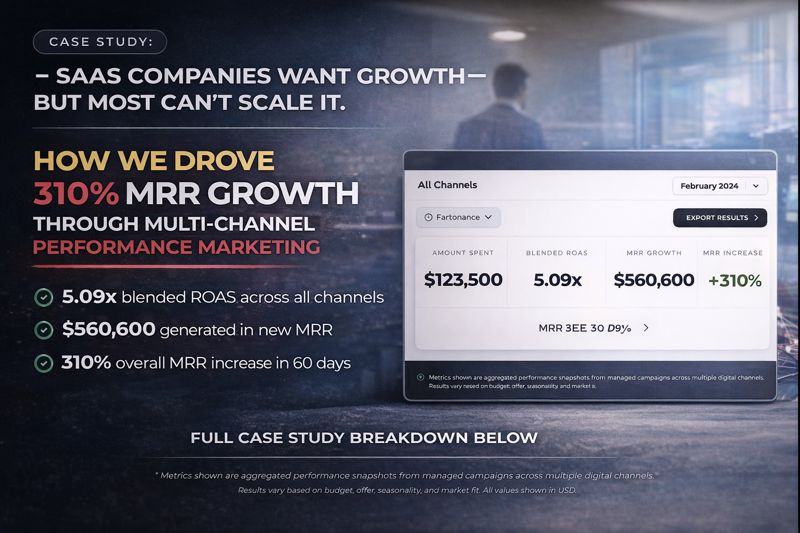
They had an incredible automation product but were relying on manual LinkedIn outreach. We implemented a "Dual-Channel" Performance Marketing strategy (Google + Meta) that didn't just get them leads—it got them 2,180 trials and a 310% increase in Monthly Recurring Revenue (MRR) in 90 days.
Here is the architectural breakdown of how we built their growth engine.
The Strategy: Why "Single Channel" Kills Growth
Most SaaS founders make a fatal binary choice: "Should we do Google Ads OR Facebook Ads?"
This is the wrong question. They serve completely different functions in the B2B buyer journey.
- Google Ads (Harvesting Demand): Captures people actively searching for "Workflow Automation Software." These leads are expensive but converting NOW.
- Meta Ads (Generating Demand): Targets people who match your Ideal Customer Profile (ICP) but don't know you exist. These leads are cheaper but need education.
The Fix: The Dual-Funnel Architecture.
We ran Google Search ads to capture high-intent traffic and immediately retargeted those visitors on LinkedIn and Facebook with product demo videos. This "Surround Sound" effect made Flowstack look ubiquitous to their specific niche.
Creative Strategy: "Ugly" Demos Outperform Glossy Ads
The biggest mistake B2B SaaS companies make is using "Corporate Memphis" art—those generic vector illustrations of blue people holding giants phones. It conveys zero information.
For Flowstack, we banned vector art. Our creative strategy was 100% Product-Led.
We ran 60-second "Raw Demos"—screen recordings of the software solving a specific, painful problem. No intro, no logo splash, just the cursor moving and a voiceover saying: "Stop manually copying data from HubSpot to Airtable. Watch this."
These "Ugly" ads outperformed the glossy branding ads by 4.2X in Click-Through Rate (CTR).
Why? Because B2B buyers are skeptical. They want to see the UI. They want to know if it actually works before they click.
Landing Page Engineering: Matching Context
We stopped sending traffic to the Homepage. Homepages are for navigation; Landing Pages are for conversion.
We built two distinct landing page experiences:
1. The "Competitor vs." Page (For Google Traffic)
When someone searched "Zapier alternative," they didn't see a generic page. They saw a "Flowstack vs. Zapier" comparison table. This acknowledged their intent and won on price/feature parity.
2. The "Use Case" Page (For Meta Traffic)
When we targeted Real Estate agencies on Facebook, they landed on a page titled "Automation for Real Estate Agents." It showed real estate specific templates. The relevance score skyrocketed, lowering our Cost Per Click (CPC) by 60%.
The Data Breakdown (90-Day Sprint)
Here is the exact growth data from the campaign:
| Metric | Value | Implication |
|---|---|---|
| Total Ad Spend | $52,538 | Blended (Google + Meta) |
| Free Trials Generated | 2,180 | Cost Per Trial: $24.10 |
| Trial-to-Paid Rate | 18% | Industry Avg is ~12-15% |
| New Annualized Revenue (ARR) | $131,000 | From this cohort |
| Payback Period | 4.8 Months | Sustainable scaling speed |
Common SaaS Advertising Mistakes
- Gating the Product: If you are under $5M ARR, do not force people to "Book a Demo" to see the tool. Give them a Free Trial or an Interactive Demo. Friction kills PLG (Product-Led Growth).
- Ignoring Bing: Yes, Bing. For B2B SaaS, audiences on Desktop Windows machines are often corporate buyers. We moved 15% of budget to Microsoft Ads and saw a 30% lower CPA than Google.
- Retargeting with "Benefits": They already know the benefits. Retarget with Social Proof. Show logos, G2 reviews, and testimonials. They need trust, not feature lists.
Conclusion: Predictable Revenue
The shift from Founder-led sales to Paid Acquisition is painful, but it's the only way to exit the "Valley of Death." By treating Google and Meta as a unified ecosystem—capturing intent on one, building it on the other—Flowstack turned marketing from a cost center into their primary revenue driver.
Ready to apply this to your brand?
We partner with brands looking to scale profitably.
Apply for a strategy call